China AI Development vs United States, Artificial Intelligence (AI) has become one of the most important technologies of the modern world. Governments, businesses, and researchers are investing billions of dollars to develop smarter AI systems that can transform industries, improve productivity, and strengthen national competitiveness.
When discussing global AI leadership, two countries dominate the conversation: China and the United States. Both nations are making massive investments in AI research, talent development, infrastructure, and innovation. As AI continues to reshape the global economy, many people wonder which country is ahead and what the future of AI competition looks like.
In this guide, we will explore China AI Development vs United States, compare their strengths and weaknesses, and examine how each country is shaping the future of artificial intelligence.
Understanding the Global AI Competition
The AI race is more than a technological contest. It affects:
- Economic growth
- National security
- Scientific research
- Healthcare innovation
- Manufacturing efficiency
- Global influence
Both China and the United States view AI as a strategic priority. Their governments and private sectors are investing heavily to gain a competitive advantage.
Why AI Matters in 2026
Artificial intelligence is now being used across many industries, including:
- Healthcare diagnostics
- Autonomous vehicles
- Financial services
- Smart manufacturing
- Cybersecurity
- Education technology
- Customer service automation
Countries that lead AI development are expected to gain significant economic and technological benefits over the next decade.
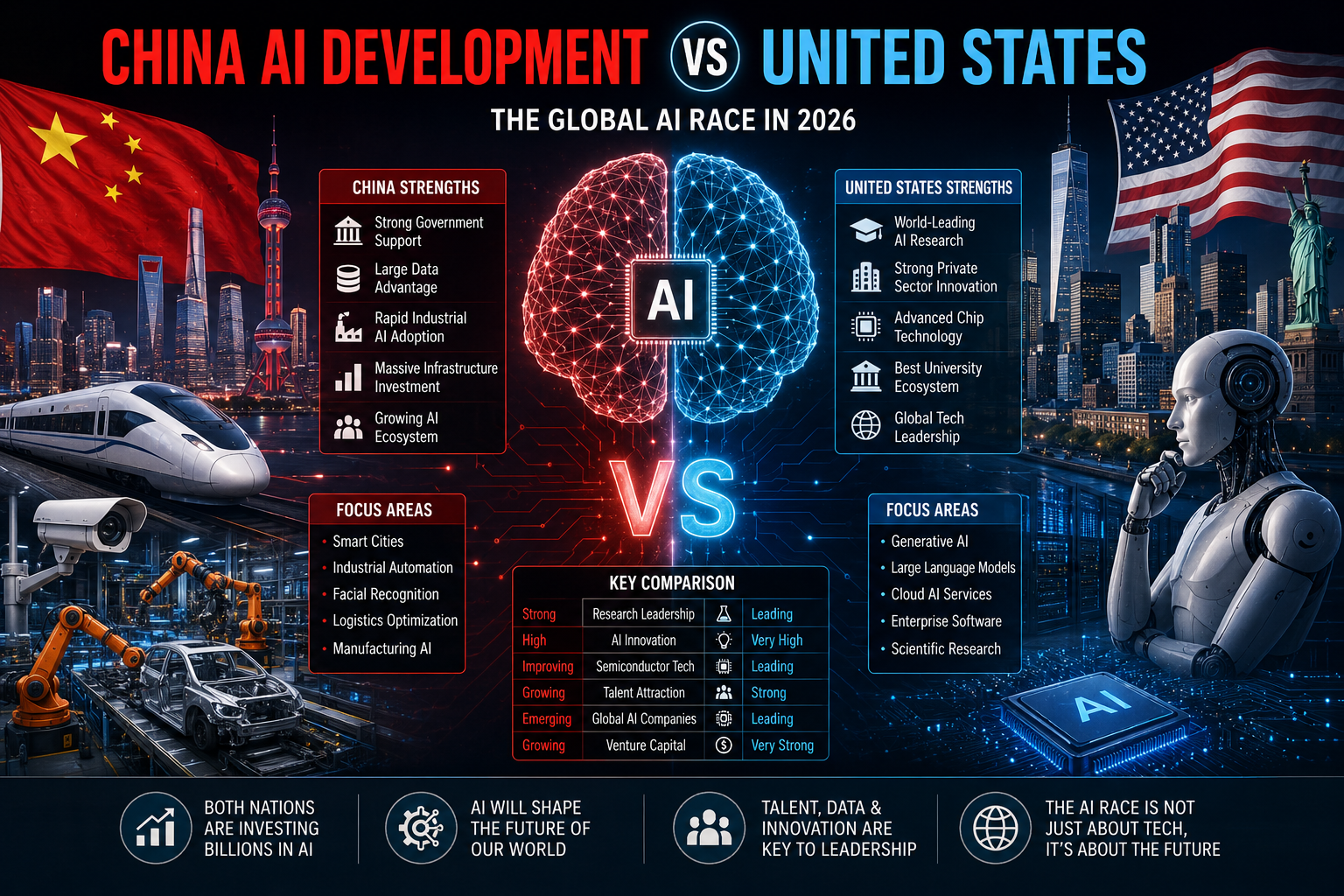
China AI Development vs United States: Quick Comparison
| Category | China | United States |
|---|---|---|
| AI Research | Rapidly growing | Global leader |
| AI Startups | Strong government support | Strong private investment |
| Semiconductor Technology | Improving but dependent on imports | Industry leader |
| Data Availability | Large population data | Strong privacy regulations |
| AI Talent | Growing quickly | World-class universities |
| Innovation Ecosystem | State-driven strategy | Market-driven innovation |
| Global AI Companies | Emerging rapidly | Home to leading AI firms |
| Computing Infrastructure | Expanding aggressively | Advanced and mature |
While both countries are advancing rapidly, their approaches differ significantly.
The United States AI Strategy
The United States has long been considered the global leader in technological innovation.
Strong Private Sector Innovation
Many of the world’s most influential AI companies are based in the United States, including:
- OpenAI
- Microsoft
- Meta
- NVIDIA
These companies invest billions of dollars annually in AI research and development.
Key Advantages
- Access to venture capital
- Strong startup ecosystem
- Leading research laboratories
- Global technology influence
- Advanced semiconductor industry
Leadership in AI Research
American universities continue to produce groundbreaking AI research.
Top institutions include:
- Massachusetts Institute of Technology
- Stanford University
- Carnegie Mellon University
- University of California, Berkeley
These institutions attract researchers from around the world and contribute significantly to AI innovation.
Advanced Semiconductor Industry
AI systems require powerful chips for training and deployment.
The United States remains dominant in:
- AI accelerator chips
- GPU technology
- Cloud computing infrastructure
- Advanced chip design
Companies like NVIDIA continue to provide the hardware powering many of today’s AI models.
China’s AI Strategy
China has transformed itself into a major AI competitor through large-scale investment and government planning.
Government-Led Development
Unlike the market-driven approach of the United States, China’s AI growth is strongly supported by government policies.
The Chinese government has:
- Established national AI strategies
- Funded research institutions
- Encouraged AI adoption across industries
- Invested heavily in infrastructure
This coordinated approach allows China to accelerate development in key sectors.
Massive Data Advantage
One of China’s greatest strengths is access to large amounts of data generated by its population.
AI systems improve through learning from data. China’s large digital ecosystem provides:
- Consumer behavior data
- Mobile payment data
- E-commerce data
- Smart city information
This helps companies train AI systems at scale.
Rapid Industrial Adoption
China is quickly integrating AI into:
- Manufacturing
- Logistics
- Transportation
- Healthcare
- Smart cities
Many Chinese factories are adopting AI-powered automation to improve productivity and efficiency.
Comparing AI Investment
Investment plays a major role in AI leadership.
| Area | China | United States |
|---|---|---|
| Government Funding | Very High | High |
| Venture Capital | Growing | Extremely Strong |
| Corporate R&D Spending | High | Very High |
| Infrastructure Investment | Massive | Massive |
| Startup Funding | Expanding | Mature Ecosystem |
The United States benefits from strong private investment, while China relies more on coordinated government support.
AI Talent: Who Has the Advantage?
Talent remains one of the most important factors in AI development.
United States Strengths
- World-renowned universities
- Attraction of international researchers
- Strong research culture
- Access to global talent
China’s Strengths
- Large STEM graduate population
- Growing research output
- Government talent programs
- Increasing domestic expertise
Talent Comparison
| Factor | China | United States |
|---|---|---|
| AI Graduates | Very High | High |
| Research Quality | Improving | Leading |
| International Talent Attraction | Moderate | Strong |
| Academic Collaboration | Growing | Extensive |
The United States currently maintains an advantage in attracting top global AI talent.
AI Infrastructure and Computing Power
Modern AI requires enormous computing resources.
United States Advantages
- Leading cloud providers
- Advanced AI chips
- Established data centers
- Strong semiconductor ecosystem
China’s Advantages
- Rapid infrastructure expansion
- National investment initiatives
- Large-scale computing projects
- Growing domestic chip development
Computing power is becoming one of the most important battlegrounds in the AI race.
AI Applications: Different Priorities
China and the United States often focus on different AI applications.
United States Focus Areas
- Generative AI
- Large language models
- Cloud AI services
- Enterprise software
- Scientific research
China Focus Areas
- Smart cities
- Industrial automation
- Facial recognition
- Logistics optimization
- Manufacturing AI
These different priorities reflect each country’s economic and strategic goals.
Challenges Facing the United States
Despite its leadership, the United States faces several challenges.
Key Challenges
- Increasing international competition
- AI regulation debates
- Talent shortages in specialized fields
- High development costs
- Supply chain concerns
Maintaining leadership will require continued investment and innovation.
Challenges Facing China
China also faces obstacles in its AI development journey.
Major Challenges
- Dependence on advanced foreign chips
- Restrictions on technology access
- Talent competition
- Research commercialization challenges
- Global trust concerns
Addressing these issues will be critical for long-term success.
The Role of AI Regulation
Regulation is becoming increasingly important.
United States Approach
The U.S. generally encourages innovation while introducing safety measures and governance frameworks.
China Approach
China applies stronger government oversight and regulatory control over AI deployment.
Both countries are trying to balance innovation with responsible AI development.
Future Trends in the AI Race
Several trends are likely to shape the future competition between China and the United States.
Emerging Trends
- More powerful AI models
- Increased chip competition
- AI-powered scientific discovery
- Autonomous systems growth
- Expansion of AI infrastructure
- Greater focus on AI safety
The race is expected to intensify throughout the remainder of the decade.
Who Is Leading in 2026?
The answer depends on the area being measured.
The United States Leads In
- Frontier AI research
- Generative AI models
- Semiconductor technology
- Venture capital ecosystem
- Global AI companies
China Leads In
- Large-scale deployment
- Government-supported initiatives
- Industrial AI adoption
- Smart city implementation
- Population-scale data utilization
Rather than a single winner, both countries currently lead in different aspects of AI development.
FAQs
What is the difference between China AI development and United States AI development?
The United States relies heavily on private-sector innovation and research institutions, while China uses a government-led strategy focused on large-scale implementation and infrastructure investment.
Which country is leading AI in 2026?
The United States leads in advanced AI research and semiconductor technology, while China excels in deployment, industrial adoption, and government-supported AI initiatives.
Why is AI important for national competitiveness?
AI improves productivity, drives innovation, supports economic growth, and strengthens technological leadership across industries.
Does China have more AI data than the United States?
China benefits from a large population and extensive digital ecosystems, which provide substantial datasets for AI training and development.
Can China surpass the United States in AI?
It is possible in certain sectors. However, the outcome will depend on future investments, talent development, semiconductor capabilities, and technological breakthroughs.
Conclusion
The debate over China AI Development vs United States is likely to continue for many years. The United States remains a leader in cutting-edge AI research, advanced chips, and innovation-driven ecosystems. Meanwhile, China has demonstrated remarkable progress through strategic planning, large-scale deployment, and government-backed investments.
Rather than viewing the competition as a simple winner-takes-all race, it is more accurate to see it as a contest between two different models of AI development. Each country possesses unique strengths that contribute to the advancement of artificial intelligence worldwide.
As AI becomes increasingly important to economic growth, national security, and technological progress, both China and the United States will continue to shape the future of the global AI landscape.