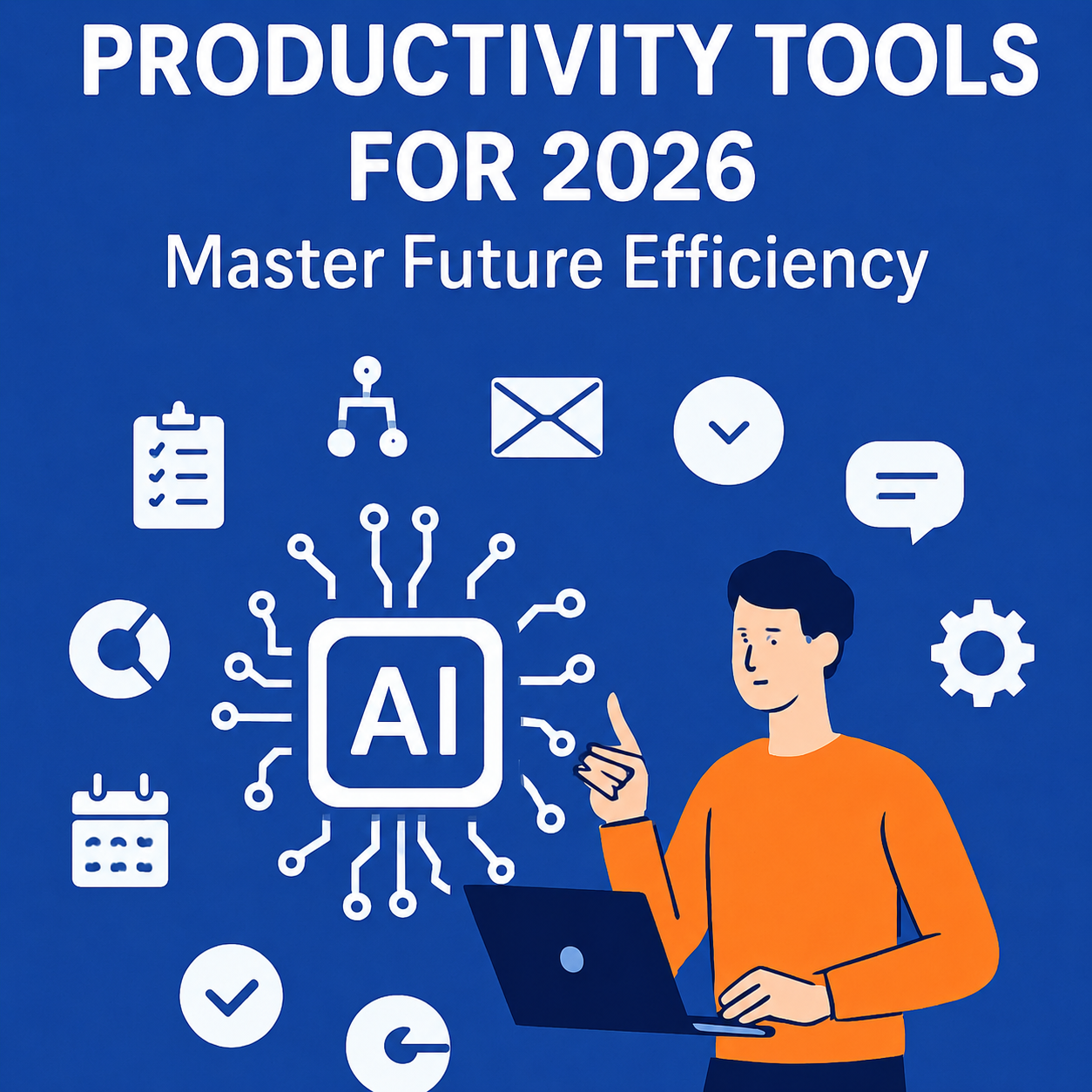
Best AI Productivity Tools, If your to-do list feels longer every week, you are not alone. Knowledge workers today juggle emails, meetings, documents, and dozens of small tasks every single day. The good news is that artificial intelligence has quietly become one of the best ways to take some of that load off your plate.
In this guide, we will walk through the best AI productivity tools available right now, what each one does well, how much they cost, and which one might fit your workflow best. Whether you write for a living, manage a team, or just want fewer hours lost to busywork, there is something here for you.
Why AI Productivity Tools Matter Right Now
AI tools used to be a novelty. Today, they are part of daily work for most professionals. Instead of replacing human judgment, the best tools take over the repetitive parts of work — drafting, summarizing, scheduling, formatting — so you can spend more time on the parts that actually need your brain.
A good AI tool should:
- Solve one specific problem really well, not promise to do everything
- Fit into the apps and habits you already use
- Be easy to learn within a day or two
- Save you measurable time, not just make you feel “more productive”
With that in mind, let’s look at the tools that consistently deliver real value in 2026.
1. ChatGPT — The All-Purpose AI Assistant
ChatGPT remains the most widely used AI assistant, and for good reason. It can draft emails, brainstorm ideas, summarize long documents, write code, and answer almost any question you throw at it.
Key features:
- Conversational chat for writing, research, and problem-solving
- Voice mode and image understanding (point your camera at something and ask about it)
- “Projects” to keep related chats and context organized
- Deep Research mode for longer, source-backed reports
- Custom GPTs for repeatable workflows
Pricing: Free plan available. Plus is $20/month and unlocks the newer models, Deep Research, and higher usage limits. A Business plan (around $20–25/user/month) adds team controls and admin features. A Pro tier exists for heavy users who need much higher limits.
Best for: Anyone who wants one flexible tool for writing, research, and everyday questions.
2. Claude — Best for Writing, Reasoning, and Long Documents
Claude, made by Anthropic, has built a strong reputation among professionals who need careful writing, detailed analysis, or help working through long documents. It tends to stay closer to the facts you give it and is a popular choice for coding and document-heavy work.
Key features:
- Strong performance on long documents, contracts, and reports
- Artifacts feature for building documents, code, and visuals you can edit live
- Projects to keep persistent context for ongoing work
- Claude Code for developers who want AI help directly in their coding workflow
Pricing: Free tier available. Claude Pro is around $20/month (less if billed annually). Higher-usage Max plans exist for people who use it heavily throughout the day. Team plans start around $25/seat/month.
Best for: Writers, analysts, and developers who need depth and accuracy over flashy extras.
3. Notion AI — Best for Notes, Docs, and Team Knowledge
Notion has long been a favorite all-in-one workspace for notes, wikis, and project tracking. Its built-in AI layer adds writing help, automatic summaries, and a “Notion Agent” that can complete multi-step tasks inside your workspace.
Key features:
- AI-assisted writing, summarizing, and translating directly in your notes
- Notion AI search that answers questions using your own team’s documents
- AI Meeting Notes that turn calls into structured summaries
- Custom Agents that can run automated, multi-step workflows
Pricing: Free plan available. Plus is around $10/user/month but only includes a limited AI trial. Full AI features require the Business plan, which runs about $20/user/month (billed annually). Enterprise pricing is custom.
Best for: Teams that already live inside Notion for documentation and want AI built into that same space.
4. Microsoft 365 Copilot — Best for Teams Already Using Word, Excel, and Outlook
If your company runs on Word, Excel, PowerPoint, and Outlook, Microsoft 365 Copilot brings AI directly into those apps instead of asking you to switch tools.
Key features:
- Draft and rewrite documents inside Word
- Build formulas, analyze data, and generate charts inside Excel
- Summarize long email threads and draft replies in Outlook
- Turn outlines or documents into slide decks in PowerPoint
- Meeting summaries and action items inside Teams
Pricing: Copilot is an add-on, not a standalone product. Small business plans start around $18–21/user/month on top of an eligible Microsoft 365 base license. The enterprise add-on is about $30/user/month. Because a base Microsoft 365 license is required, your real monthly cost is usually higher than the headline price, so it’s worth checking Microsoft’s current pricing page before budgeting.
Best for: Organizations already deep in the Microsoft ecosystem that want AI without changing their core software.
5. Grammarly — Best for Polished, Error-Free Writing
Grammarly has grown far beyond a spell-checker. It now offers tone suggestions, full-sentence rewrites, and plagiarism checks, and it works almost everywhere you type — browsers, email, Word, and Google Docs.
Key features:
- Real-time grammar, spelling, and punctuation checks
- Tone detection so you don’t accidentally sound harsh in an email
- Full-sentence and paragraph rewrites
- Plagiarism and AI-text detection on paid plans
- Works across nearly every app and browser
Pricing: Free plan covers basic grammar and spelling checks. Pro costs about $12/month when billed annually (around $30/month if billed monthly). Enterprise plans are custom-priced for larger teams.
Best for: Anyone whose job depends on clear, professional writing — marketers, students, customer support teams, and non-native English speakers especially.
6. Otter.ai and Fireflies.ai — Best for Meeting Notes and Transcripts
If you spend half your week in video calls, an AI meeting assistant can save hours. Both Otter.ai and Fireflies.ai join your calls, transcribe them in real time, and generate summaries with action items afterward.
Key features:
- Automatic transcription of Zoom, Google Meet, and Microsoft Teams calls
- AI-generated summaries and action items after each meeting
- Searchable archive of past meetings
- CRM integrations (Fireflies has stronger options here for sales teams)
Pricing: Both offer free plans with limited monthly minutes. Otter’s Pro plan starts around $8–17/month depending on billing, with Business plans around $20–30/user/month. Fireflies’ Pro plan starts around $10–18/month, with Business plans around $19–29/user/month. Watch for “AI credit” systems on some plans, since heavy use of AI summaries can eat through your monthly allowance faster than expected.
Best for: Sales teams, consultants, and anyone who hates writing meeting notes by hand.
7. Zapier — Best for Connecting Your Apps and Automating Busywork
Zapier doesn’t generate content itself — instead, it connects the apps you already use so information flows between them automatically. Pair it with AI tools, and it becomes a control center that can summarize, sort, and route information without you lifting a finger.
Key features:
- Connects thousands of apps (Gmail, Slack, Notion, spreadsheets, and more)
- AI-powered Copilot to help you build automations using plain language
- Pre-built templates for common workflows
- Tables and Forms for lightweight data collection, included on most plans
Pricing: Free plan covers 100 tasks/month with simple two-step automations. The Professional plan starts around $30/month for 750 tasks, and costs rise with usage. Team and Enterprise plans are available for larger organizations.
Best for: Anyone tired of manually copying information between apps, or building repetitive workflows by hand.
8. Motion — Best for AI-Powered Scheduling and Task Management
Motion automatically organizes your calendar around your priorities, rearranging tasks and meetings as your day changes. It has grown into more of an all-in-one project hub, with notes, docs, and meeting recording built in.
Key features:
- AI calendar that automatically schedules and reshuffles your tasks
- Task prioritization based on deadlines and importance
- Meeting recorder that creates tasks directly from call notes
- Team capacity planning on higher tiers
Pricing: Pro AI plans start around $19/seat/month (billed annually), with Business AI around $29/seat/month for team features like capacity planning.
Best for: People who constantly battle calendar chaos and want AI to handle the rescheduling for them.
9. Canva Magic Studio — Best for Quick, Professional-Looking Design
You don’t need design skills to create polished graphics anymore. Canva’s Magic Studio uses AI to turn rough ideas into presentations, social posts, and marketing graphics in minutes.
Key features:
- Magic Write for generating text content inside designs
- Magic Design for instant layout suggestions based on a prompt or uploaded photo
- Background removal and image editing tools
- Huge library of templates across formats (social posts, decks, documents)
Pricing: Free plan is generous for individuals. Canva Pro runs around $13–15/month for individuals, with Teams plans priced per user for collaborative workspaces.
Best for: Marketers, small business owners, and anyone who needs good-looking visuals without hiring a designer.
10. Perplexity — Best for Fast, Source-Backed Research
When you need quick, trustworthy answers instead of a wall of search results, Perplexity acts like a research assistant that reads multiple sources and gives you a cited summary.
Key features:
- Answers questions with citations to original sources
- Follow-up questions to dig deeper into a topic
- Focus modes for academic, video, or shopping-specific searches
- Browser extension for quick lookups while you work
Pricing: Free plan available with daily limits. Pro is around $20/month and adds more searches, file uploads, and access to multiple AI models.
Best for: Researchers, students, and anyone who needs quick answers they can actually verify.
Comparison Table: Best AI Productivity Tools at a Glance
| Tool | Best For | Starting Price (Paid Plan) | Free Plan? |
|---|---|---|---|
| ChatGPT | General writing, research, brainstorming | $20/month (Plus) | Yes |
| Claude | Long documents, analysis, coding | ~$20/month (Pro) | Yes |
| Notion AI | Notes, docs, team knowledge base | ~$20/user/month (Business) | Yes (limited AI) |
| Microsoft 365 Copilot | Word, Excel, Outlook, Teams users | ~$18–30/user/month + base license | No |
| Grammarly | Writing, grammar, tone | ~$12/month (Pro, annual) | Yes |
| Otter.ai / Fireflies.ai | Meeting transcripts and notes | ~$8–18/month | Yes |
| Zapier | App automation, workflows | ~$30/month (Professional) | Yes |
| Motion | AI calendar and task scheduling | ~$19/seat/month | No (free trial only) |
| Canva Magic Studio | Design and visual content | ~$13–15/month | Yes |
| Perplexity | Quick, cited research answers | ~$20/month (Pro) | Yes |
Note: AI tool pricing changes frequently. Always check each company’s official pricing page before subscribing, since the numbers above can shift within months.
How to Choose the Right AI Tool for You
With so many options, it helps to match the tool to the actual problem you’re trying to solve rather than picking the most popular name.
- If your biggest time-waster is writing: Start with ChatGPT, Claude, or Grammarly.
- If meetings eat your day: Try Otter.ai or Fireflies.ai.
- If your calendar is constant chaos: Motion is built exactly for this.
- If you’re drowning in repetitive manual tasks: Zapier will likely save you the most hours.
- If your team already lives in Microsoft or Notion: Use the AI features built into the tool you already pay for before adding something new.
A simple rule that works well: pick one or two tools that solve your biggest pain point, use them daily for a few weeks, and only then consider adding more. Trying to adopt five new AI tools at once usually leads to confusion, not productivity.
Tips for Getting the Most Out of AI Productivity Tools
- Be specific with your prompts. “Summarize this report in 5 bullet points for a non-technical audience” works far better than “summarize this.”
- Always double-check important outputs. AI tools can sound confident even when they’re wrong, especially with numbers, dates, or quotes.
- Connect tools where possible. Linking your meeting recorder, calendar, and notes app saves more time than using each one in isolation.
- Review your usage every few months. Pricing and features in this space change quickly, and a tool that was perfect six months ago might have a cheaper or better alternative today.
- Start with free plans. Almost every tool on this list has a free tier — test it for a week before paying for anything.
Frequently Asked Questions
1. What is the single best AI productivity tool for beginners?
ChatGPT is the easiest starting point because it handles a wide range of tasks with a simple chat interface and has a solid free plan.
2. Are AI productivity tools safe to use with confidential work information?
Most paid business plans (like ChatGPT Business, Claude Team, and Microsoft 365 Copilot) exclude your data from model training by default. Free or personal plans are generally less strict, so avoid pasting sensitive company data into a free-tier tool unless you’ve confirmed its privacy policy.
3. Do I need to pay for these tools, or are the free plans good enough?
For occasional use, free plans are often enough. If a tool becomes part of your daily workflow, the time saved usually justifies the cost of upgrading — most paid plans pay for themselves within a few hours of saved work each month.
4. Can AI tools replace human writers, assistants, or designers?
Not entirely. They’re best used to handle first drafts, repetitive tasks, and time-consuming busywork, while humans still handle judgment, creativity, and final quality checks.
5. How many AI tools should I actually use at once?
Most people do well with two or three tools that solve their biggest pain points — for example, one writing assistant, one meeting tool, and one automation tool. Adding more than that often creates extra complexity instead of saving time.
6. Will AI productivity tool pricing change?
Yes, frequently. Several tools in this list have changed their pricing structure in the past year alone. Always check the official pricing page before subscribing.
Conclusion
The best AI productivity tools in 2026 aren’t the ones with the longest feature list — they’re the ones that quietly remove friction from your actual workday. Whether that means ChatGPT or Claude handling your writing, Otter.ai capturing your meetings, Zapier automating your busywork, or Motion taming your calendar, the right pick depends entirely on where you personally lose the most time.
Start small. Pick the one tool from this list that solves your biggest daily headache, use it consistently for a couple of weeks, and build your AI toolkit from there. That’s how real productivity gains happen — not from chasing every new tool, but from going deep with the few that actually fit how you work.