
Introduction
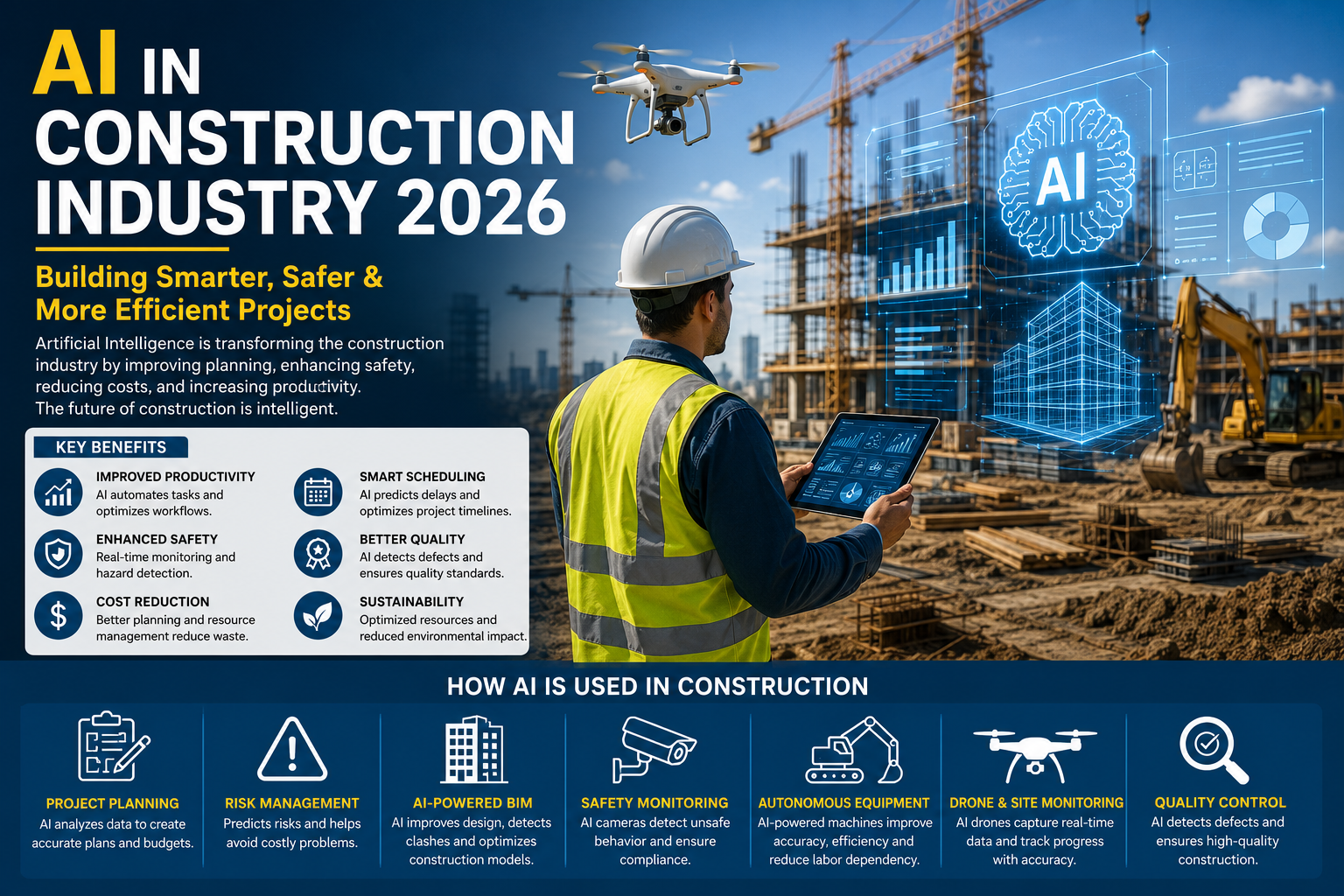
AI in Construction Industry 2026, The construction sector is experiencing a major transformation in 2026. Traditional methods are being replaced by advanced technologies that improve efficiency, safety, and productivity. One of the biggest innovations driving this change is Artificial Intelligence (AI).
AI in Construction Industry 2026 is no longer a futuristic concept. Construction companies around the world are using AI-powered tools to manage projects, reduce costs, improve safety, and make better decisions. From predictive analytics to autonomous equipment, AI is reshaping how buildings, roads, bridges, and infrastructure projects are designed and constructed.
In this article, we will explore how AI is being used in construction, its benefits, challenges, future trends, and why it is becoming essential for modern construction companies.
What Is AI in Construction?
Artificial Intelligence refers to computer systems that can perform tasks that normally require human intelligence. These tasks include:
- Learning from data
- Identifying patterns
- Predicting outcomes
- Making recommendations
- Automating repetitive work
In construction, AI helps companies analyze large amounts of project data and make smarter decisions throughout the project lifecycle.
Why AI Is Important in Construction in 2026
The construction industry faces several challenges, including:
- Rising labor costs
- Project delays
- Budget overruns
- Safety concerns
- Material waste
AI helps solve these issues by providing accurate insights and automation.
Key Reasons AI Is Growing in Construction
| Challenge | AI Solution |
|---|---|
| Project delays | Predictive scheduling |
| Cost overruns | Budget forecasting |
| Safety risks | Real-time hazard detection |
| Labor shortages | Construction automation |
| Material waste | Resource optimization |
As a result, companies can complete projects faster and more efficiently.
How AI Is Used in Construction Industry 2026
AI applications continue to expand across every stage of construction.
1. AI-Powered Project Planning
Before construction begins, AI analyzes:
- Historical project data
- Weather conditions
- Material availability
- Labor requirements
- Site information
This allows project managers to create more accurate schedules and budgets.
Benefits
- Better planning accuracy
- Reduced delays
- Improved resource allocation
- Lower project costs
2. Predictive Analytics for Risk Management
One of the most valuable AI applications is predictive analytics.
AI systems examine thousands of project variables and identify risks before they become major problems.
Examples
- Equipment breakdown prediction
- Budget risk analysis
- Weather-related delays
- Labor shortages
This proactive approach helps construction firms avoid costly disruptions.
3. AI-Driven Building Information Modeling (BIM)
Building Information Modeling (BIM) has become smarter with AI integration.
AI-enhanced BIM systems can:
- Detect design conflicts
- Recommend design improvements
- Optimize material usage
- Improve project collaboration
Traditional BIM vs AI-Enhanced BIM
| Feature | Traditional BIM | AI-Enhanced BIM |
|---|---|---|
| Design Analysis | Manual | Automated |
| Clash Detection | Limited | Advanced |
| Optimization | Basic | Intelligent |
| Decision Making | Human-driven | AI-assisted |
4. Construction Site Safety Monitoring
Construction sites can be dangerous environments.
AI-powered cameras and sensors monitor job sites in real time and identify safety risks.
AI Safety Features
- PPE detection
- Unsafe behavior monitoring
- Hazard recognition
- Fall prevention alerts
- Equipment safety checks
Benefits
- Fewer workplace accidents
- Improved compliance
- Lower insurance costs
- Enhanced worker protection
Safety remains one of the most impactful uses of AI in Construction Industry 2026.
5. Autonomous Construction Equipment
Heavy machinery is becoming increasingly autonomous.
Examples include:
- Self-driving bulldozers
- Autonomous excavators
- AI-powered cranes
- Smart loaders
These machines use:
- GPS
- Computer vision
- Sensors
- Machine learning
to perform tasks with minimal human intervention.
Advantages
- Increased productivity
- Reduced labor dependency
- Greater accuracy
- Lower operational costs
6. AI for Quality Control
Quality control is critical in construction projects.
AI-powered systems use cameras and image recognition to inspect construction work.
They Can Detect:
- Structural defects
- Material damage
- Incorrect installations
- Design deviations
This improves project quality and reduces costly rework.
7. Smart Construction Scheduling
Scheduling errors often lead to project delays.
AI analyzes:
- Workforce availability
- Equipment usage
- Material deliveries
- Site conditions
to automatically adjust schedules when changes occur.
Benefits
- Faster project completion
- Improved workflow
- Better coordination
- Reduced downtime
8. AI-Powered Drones
Drones have become essential tools in modern construction.
When combined with AI, drones can:
- Survey land
- Monitor progress
- Create 3D maps
- Inspect structures
- Track site activity
Drone Benefits
| Function | Benefit |
|---|---|
| Site Surveying | Faster data collection |
| Progress Tracking | Real-time updates |
| Inspection | Improved accuracy |
| Mapping | Detailed project visualization |
Benefits of AI in Construction Industry 2026
The adoption of AI offers significant advantages.
Improved Productivity
AI automates repetitive tasks and allows workers to focus on more valuable activities.
Results
- Faster workflows
- Increased efficiency
- Better project outcomes
Reduced Costs
AI identifies inefficiencies and helps reduce unnecessary spending.
Cost Savings Areas
- Labor management
- Material usage
- Equipment maintenance
- Project scheduling
Better Decision Making
Construction leaders can access real-time insights and accurate forecasts.
This leads to:
- Smarter investments
- Better planning
- Reduced risks
Enhanced Safety
AI continuously monitors work environments and identifies hazards before accidents occur.
Safety Improvements
- Reduced injuries
- Better compliance
- Increased worker confidence
Sustainable Construction
AI helps construction companies become more environmentally responsible.
Sustainability Benefits
- Less material waste
- Lower energy consumption
- Optimized resource usage
- Reduced carbon emissions
Challenges of AI Adoption in Construction
Although AI offers many benefits, some challenges remain.
High Initial Investment
Implementing AI systems can require substantial upfront costs.
Expenses may include:
- Software licenses
- Hardware upgrades
- Training programs
- Data infrastructure
Workforce Training Requirements
Employees need training to effectively use AI tools.
Companies must invest in:
- Technical education
- Digital skills development
- AI awareness programs
Data Quality Issues
AI relies on accurate and reliable data.
Poor-quality data can result in:
- Incorrect predictions
- Project inefficiencies
- Decision-making errors
Resistance to Change
Some organizations are hesitant to adopt new technologies.
Common concerns include:
- Job displacement fears
- Technology complexity
- Implementation challenges
However, industry trends indicate growing acceptance of AI solutions.
Future Trends of AI in Construction Beyond 2026
AI technology will continue evolving rapidly.
Emerging Trends
1. Digital Twins
Digital twins create virtual versions of physical structures.
Benefits include:
- Real-time monitoring
- Predictive maintenance
- Performance optimization
2. AI-Powered Robotics
Construction robots will handle:
- Bricklaying
- Concrete pouring
- Welding
- Demolition
3. Generative Design
AI will automatically create optimized building designs based on project requirements.
4. Advanced Predictive Maintenance
Equipment failures will be predicted before they occur, reducing downtime and repair costs.
5. Fully Connected Smart Construction Sites
Future construction sites will integrate:
- AI
- IoT sensors
- Robotics
- Cloud computing
for seamless project management.
Steps for Construction Companies to Implement AI
Organizations interested in adopting AI should follow these steps:
Step 1: Assess Current Processes
Identify areas where AI can improve efficiency.
Step 2: Collect High-Quality Data
Build a reliable data foundation.
Step 3: Choose the Right AI Solutions
Select tools that address specific business needs.
Step 4: Train Employees
Provide training and support for successful adoption.
Step 5: Start with Pilot Projects
Test AI technologies on smaller projects before large-scale implementation.
Step 6: Measure Results
Track performance improvements and adjust strategies accordingly.
AI in Construction Industry 2026: Key Takeaways
| Area | AI Impact |
|---|---|
| Planning | Better forecasting |
| Safety | Hazard detection |
| Scheduling | Automated adjustments |
| Equipment | Predictive maintenance |
| Quality Control | Defect identification |
| Sustainability | Reduced waste |
| Productivity | Faster project delivery |
Frequently Asked Questions (FAQs)
1. What is AI in Construction Industry 2026?
AI in Construction Industry 2026 refers to the use of artificial intelligence technologies to improve planning, safety, productivity, quality control, and project management in construction projects.
2. How does AI improve construction safety?
AI uses cameras, sensors, and machine learning algorithms to detect hazards, monitor worker behavior, and identify safety risks in real time.
3. Can AI reduce construction costs?
Yes. AI helps optimize resource allocation, improve scheduling, predict risks, and minimize material waste, leading to significant cost savings.
4. What are the biggest AI applications in construction?
Major applications include predictive analytics, BIM optimization, autonomous equipment, drone monitoring, quality control, and project scheduling.
5. Will AI replace construction workers?
AI is more likely to assist workers rather than replace them. It automates repetitive tasks while allowing skilled workers to focus on higher-value responsibilities.
Conclusion
The growth of AI in Construction Industry 2026 marks a significant shift toward smarter, safer, and more efficient construction practices. AI-powered technologies are helping companies improve project planning, enhance safety, reduce costs, and increase productivity.
As digital transformation continues, AI will become a standard part of construction operations rather than an optional tool. Companies that embrace AI today will be better positioned to compete, innovate, and succeed in the future construction landscape. By combining human expertise with intelligent technology, the construction industry is building a smarter future for generations to come.