Introduction
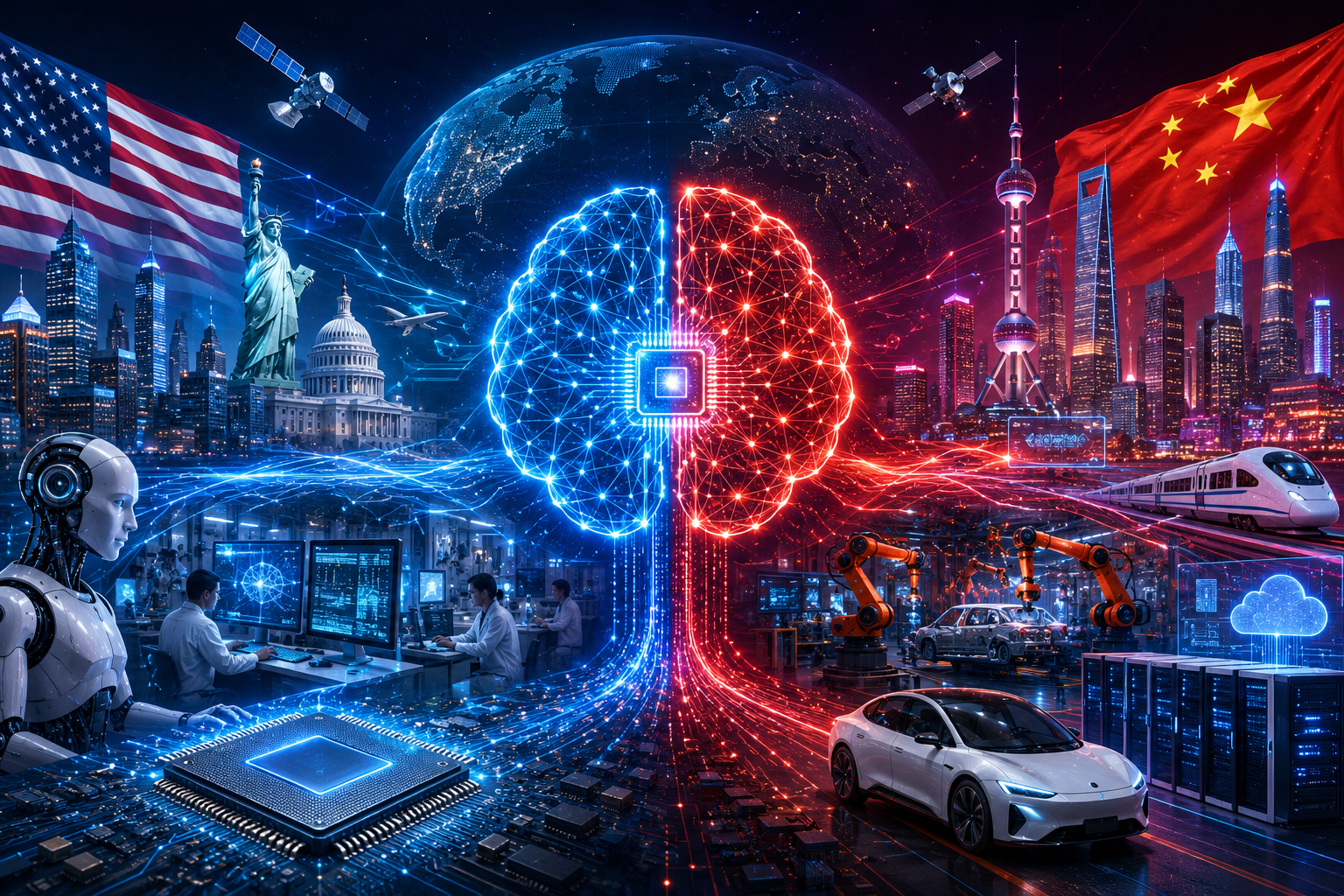
The US China AI Race 2026 has become one of the most important global technology competitions of the decade. Artificial Intelligence (AI) is transforming industries, economies, national security systems, and everyday life. As the world’s two largest economies, the United States and China are investing billions of dollars to become leaders in AI innovation.
From advanced AI models and semiconductor manufacturing to military applications and economic development, both nations are competing to shape the future of technology. The outcome of this race could influence global markets, technological standards, and geopolitical power for many years.
In this article, we will explore the current state of the US-China AI competition, key areas of rivalry, strengths and weaknesses of both countries, and what to expect in 2026 and beyond.
Understanding the US China AI Race
The AI race refers to the competition between the United States and China to develop and deploy advanced artificial intelligence technologies.
Both countries view AI as a strategic asset because it can improve:
- Economic growth
- National security
- Healthcare systems
- Manufacturing efficiency
- Transportation networks
- Scientific research
- Defense capabilities
Governments and private companies are investing heavily in AI research, infrastructure, and talent development to gain a competitive advantage.
Why AI Matters in 2026
Artificial Intelligence is no longer a future concept. In 2026, AI powers:
- Virtual assistants
- Self-driving technologies
- Smart factories
- Financial services
- Cybersecurity systems
- Medical diagnostics
- Educational platforms
- Content creation tools
Countries leading in AI development may gain significant economic and strategic benefits.
Key Areas of Competition
1. AI Research and Innovation
Research remains the foundation of AI leadership.
The United States has historically dominated AI research through:
- Leading universities
- Strong venture capital funding
- Innovative startups
- Global technology companies
China has rapidly expanded its research ecosystem by:
- Increasing government funding
- Supporting AI-focused universities
- Encouraging public-private partnerships
- Building national AI laboratories
Research Comparison
| Factor | United States | China |
|---|---|---|
| University Research | Strong | Growing Fast |
| Private Investment | Very High | High |
| Government Support | Strong | Very Strong |
| Startup Ecosystem | Mature | Expanding |
| Global AI Influence | High | Increasing |
2. AI Talent Competition
AI development depends heavily on skilled professionals.
The United States attracts top talent from around the world due to:
- Prestigious universities
- Competitive salaries
- Strong startup culture
China is investing aggressively in:
- STEM education
- AI training programs
- Research institutes
- Talent recruitment initiatives
Challenges
United States
- Immigration restrictions
- Growing talent shortages
China
- Competition for world-class researchers
- Dependence on international expertise in some areas
The Semiconductor Battle
Why Chips Are Critical
Advanced AI systems require powerful semiconductors to train and operate large models.
Without high-performance chips, AI development becomes significantly more difficult.
Importance of AI Chips
- Faster model training
- Better performance
- Energy efficiency
- Advanced computing capabilities
US Advantage in Advanced Chips
The United States maintains a significant lead in:
- Chip design
- AI processors
- Semiconductor software tools
Major American companies continue to produce cutting-edge AI hardware used globally.
Strengths
- Strong innovation ecosystem
- Advanced chip architecture
- Global technology partnerships
China’s Semiconductor Push
China is investing billions to strengthen domestic semiconductor production.
Its goals include:
- Reducing dependence on foreign suppliers
- Developing local chip manufacturers
- Expanding semiconductor research
Despite progress, advanced chip manufacturing remains one of China’s biggest challenges in 2026.
Government Policies Driving the AI Race
Government support plays a major role in AI advancement.
United States Strategy
The US focuses on:
- Research grants
- Public-private collaboration
- AI safety initiatives
- National security applications
Priority Areas
- Advanced AI systems
- Defense technology
- Responsible AI development
- Semiconductor innovation
China’s AI Strategy
China’s government has established long-term plans to become a global AI leader.
Its strategy includes:
- Large-scale investment
- National AI development programs
- Industrial modernization
- Smart city projects
Priority Areas
- Manufacturing automation
- Surveillance technology
- Digital infrastructure
- Industrial AI adoption
AI and National Security
Artificial intelligence is becoming increasingly important in defense and security operations.
Military Applications
AI can support:
- Intelligence analysis
- Autonomous systems
- Cybersecurity
- Battlefield decision-making
- Logistics optimization
Because of these capabilities, AI leadership is viewed as a strategic national priority by both countries.
The Role of Big Tech Companies
Private companies are driving much of the AI innovation worldwide.
Leading US Technology Firms
American companies continue to dominate many areas of AI development through:
- Large language models
- Cloud computing
- AI research labs
- Enterprise AI solutions
Their access to capital and global markets provides a significant advantage.
Leading Chinese Technology Firms
Chinese technology companies are rapidly advancing in:
- Consumer AI applications
- E-commerce integration
- Smart manufacturing
- Mobile ecosystem innovation
They benefit from a large domestic market and strong government support.
Data: A Major Competitive Advantage
Data is often called the fuel of AI.
AI systems learn by analyzing large datasets.
United States Data Strengths
- Diverse digital economy
- Advanced cloud infrastructure
- Strong enterprise datasets
Challenges
- Privacy regulations
- Data governance concerns
China Data Strengths
China benefits from:
- Massive population
- Large digital platforms
- Extensive online activity
Challenges
- International trust concerns
- Data-sharing restrictions
AI Regulation and Ethics
As AI becomes more powerful, governments must address risks.
Important concerns include:
- Privacy protection
- Bias in AI systems
- Misinformation
- Job displacement
- National security threats
US Approach to AI Regulation
The United States generally emphasizes:
- Innovation
- Transparency
- Industry collaboration
- AI safety standards
China’s Regulatory Approach
China focuses on:
- Government oversight
- Content controls
- Security requirements
- Platform accountability
Both approaches aim to balance innovation with safety, though their methods differ significantly.
Economic Impact of the AI Race
AI is expected to contribute trillions of dollars to the global economy.
Benefits for the United States
- Increased productivity
- New technology industries
- High-paying jobs
- Stronger global competitiveness
Benefits for China
- Industrial modernization
- Manufacturing efficiency
- Economic growth
- Technological self-sufficiency
Major Challenges Facing Both Countries
Neither nation has a guaranteed path to AI dominance.
Challenges for the United States
- Rising competition
- Workforce shortages
- Regulatory uncertainty
- Supply chain vulnerabilities
Challenges for China
- Semiconductor limitations
- Export restrictions
- Global trust concerns
- Access to advanced technology
Who Is Leading the US China AI Race 2026?
The answer depends on the category being measured.
| Area | Leader |
|---|---|
| AI Research | United States |
| Advanced AI Models | United States |
| Venture Capital Investment | United States |
| Government Coordination | China |
| AI Adoption Scale | China |
| Manufacturing AI | China |
| Advanced Semiconductors | United States |
| AI Infrastructure Growth | China |
Overall, the United States maintains leadership in cutting-edge AI innovation and advanced semiconductor technology, while China excels in large-scale implementation and government-backed development.
Future Trends Beyond 2026
Several trends are likely to shape the next phase of competition:
1. More Powerful AI Models
Future AI systems will become increasingly capable across multiple industries.
2. Semiconductor Innovation
Advanced chip development will remain a major strategic priority.
3. AI Regulation Expansion
Governments worldwide will introduce new AI policies and standards.
4. Global Partnerships
Countries may form alliances to strengthen AI capabilities.
5. Increased Competition
The AI race will likely intensify as technological breakthroughs accelerate.
What the AI Race Means for the World
The US-China competition affects more than just two countries.
Potential global impacts include:
- Faster innovation
- New economic opportunities
- Technology standards development
- Changes in international trade
- Greater geopolitical competition
Businesses, governments, and consumers worldwide will feel the effects of AI advancements coming from both nations.
FAQs About US China AI Race 2026
What is the US China AI Race 2026?
It refers to the competition between the United States and China to become the global leader in artificial intelligence technologies and innovation.
Why is AI important for national security?
AI can improve intelligence gathering, cybersecurity, autonomous systems, and military decision-making capabilities.
Which country currently leads in AI?
The United States generally leads in advanced AI research, foundation models, and semiconductor technology, while China leads in large-scale AI deployment and government-backed initiatives.
Why are semiconductors important in the AI race?
Advanced chips provide the computing power needed to train and operate sophisticated AI systems efficiently.
How will the AI race affect ordinary people?
It may lead to better products, smarter services, new jobs, increased automation, and faster technological innovation across many industries.
Conclusion
The US China AI Race 2026 represents one of the most significant technology competitions in modern history. Both nations are investing heavily in research, talent, infrastructure, and semiconductor development to secure leadership in artificial intelligence.
While the United States currently maintains an edge in advanced AI innovation and cutting-edge chips, China continues to make remarkable progress through large-scale deployment, government support, and industrial integration. The race is far from over, and future breakthroughs could quickly change the competitive landscape.
As AI becomes increasingly central to economic growth, national security, and global influence, the outcome of this competition will shape the future of technology and society for decades to come.