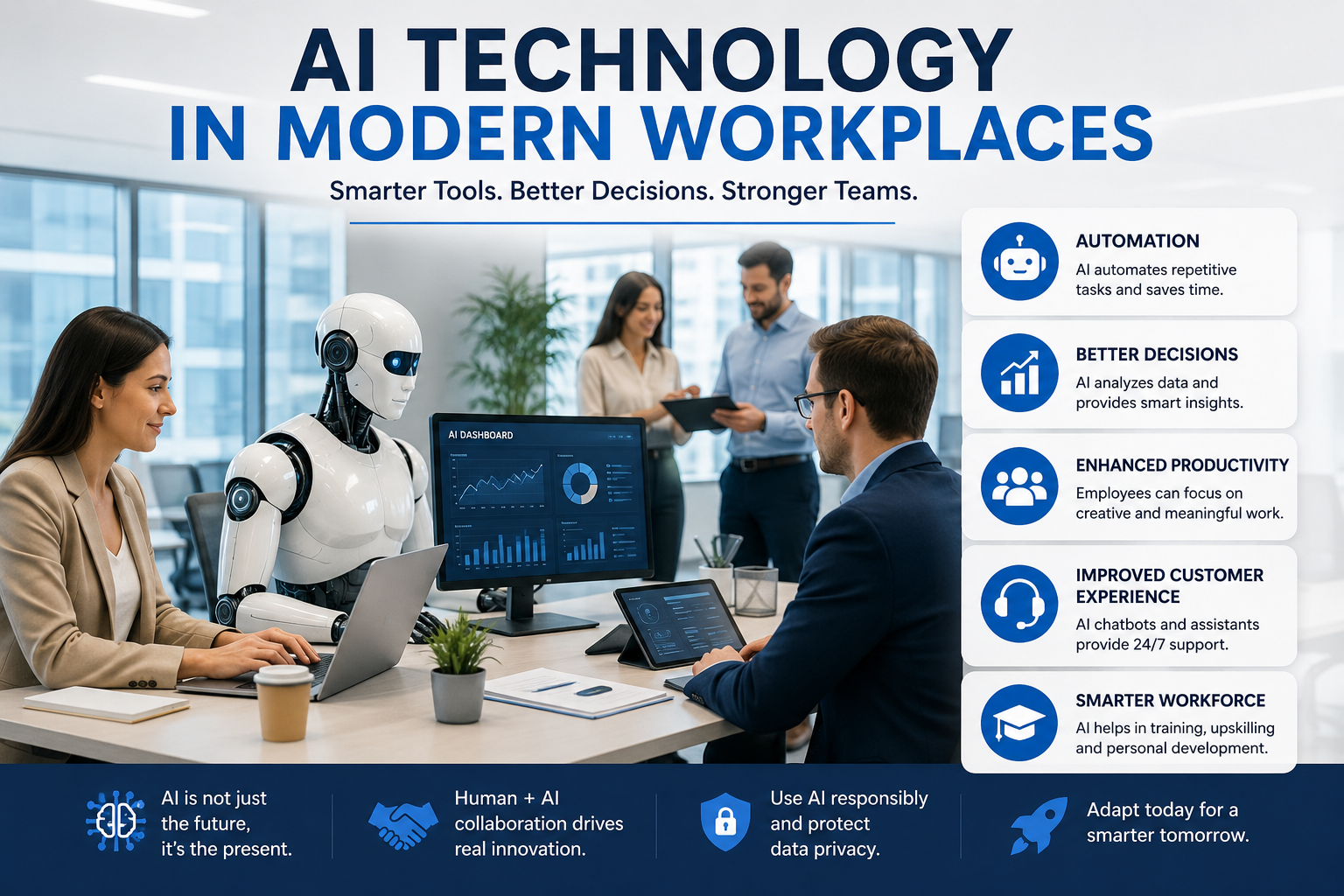
Artificial Intelligence (AI) is no longer just a futuristic idea. It is now a core part of how modern companies operate. From automating routine tasks to improving decision-making, AI technology in modern workplaces is reshaping how people work, communicate, and grow businesses.
Today, organizations of all sizes—from startups to global enterprises—are using AI tools to increase productivity, reduce costs, and improve employee experience. In this article, we will explore how AI is changing workplaces, its benefits, challenges, real-world use cases, and how businesses can successfully adopt it.
What is AI Technology in the Workplace?
AI in the workplace refers to the use of intelligent systems and software that can perform tasks that normally require human intelligence. These tasks include:
- Data analysis
- Decision-making support
- Customer communication
- Process automation
- Predictive forecasting
Instead of replacing humans completely, AI works as a support system that helps employees do their jobs faster and more efficiently.
How AI is Changing Modern Workplaces
AI is transforming traditional offices into smart, data-driven environments. Here are some major changes:
1. Automation of Repetitive Tasks
Many routine tasks are now handled by AI systems, such as:
- Email sorting and responses
- Data entry
- Scheduling meetings
- Generating reports
This allows employees to focus on more important and creative work.
2. Smarter Decision-Making
AI tools analyze large amounts of data and provide insights that help managers make better decisions.
For example:
- Sales forecasting
- Customer behavior analysis
- Risk assessment
3. Improved Communication
AI-powered chatbots and virtual assistants improve communication inside and outside the company.
- 24/7 customer support
- Instant responses to employee queries
- Faster ticket resolution
4. Enhanced Hiring Process
Recruitment has become more efficient with AI tools that:
- Screen resumes automatically
- Match candidates with job roles
- Conduct initial chatbot interviews
5. Personalized Work Experience
AI helps customize training programs, workflows, and even work schedules based on employee behavior and performance.
Benefits of AI Technology in Modern Workplaces
AI brings several advantages that make businesses more competitive and efficient.
Key Benefits:
- Higher productivity
- Reduced operational costs
- Faster decision-making
- Improved accuracy
- Better customer experience
- Increased employee satisfaction
Table: Traditional Workplace vs AI-Powered Workplace
| Feature | Traditional Workplace | AI-Powered Workplace |
|---|---|---|
| Task Handling | Manual work | Automated processes |
| Decision Making | Human judgment only | Data-driven insights |
| Customer Support | Limited hours | 24/7 AI chatbots |
| Recruitment | Time-consuming | AI-based screening |
| Productivity | Slower workflows | Faster and optimized |
| Error Rate | Higher | Lower due to automation |
Common AI Tools Used in Modern Workplaces
Different industries use different AI tools depending on their needs. Some popular categories include:
1. AI Chatbots
Used for customer service and internal support.
2. Data Analytics Tools
Help businesses understand trends and patterns.
3. AI Writing Assistants
Used for creating emails, reports, and content.
4. Project Management AI
Tools that help assign tasks and track progress automatically.
5. HR Automation Tools
Used for hiring, onboarding, and employee performance tracking.
How to Implement AI in the Workplace (Step-by-Step Guide)
Introducing AI into a business requires proper planning. Here is a simple step-by-step process:
Step 1: Identify Business Needs
Understand which areas need improvement:
- Customer service
- Marketing
- HR
- Operations
Step 2: Choose the Right AI Tools
Select tools that match your goals. For example:
- Chatbots for customer support
- Analytics tools for sales data
Step 3: Train Employees
Employees must learn how to use AI tools effectively.
- Conduct workshops
- Provide online training
- Share user guides
Step 4: Start with Small Projects
Begin with one department before scaling AI across the company.
Step 5: Monitor Performance
Track improvements in:
- Efficiency
- Cost savings
- Employee productivity
Step 6: Scale AI Usage
Once successful, expand AI tools to other departments.
Challenges of AI in Modern Workplaces
Even though AI offers many benefits, it also comes with challenges.
1. Job Concerns
Some employees fear that AI might replace their jobs.
2. High Initial Cost
Implementing AI systems can be expensive for small businesses.
3. Data Privacy Issues
AI systems need large amounts of data, which raises privacy concerns.
4. Lack of Skilled Workers
Not all employees are trained to work with AI tools.
5. Over-Reliance on Technology
Too much dependence on AI may reduce human judgment in decision-making.
Real-World Use Cases of AI in Workplaces
AI is already being used in many industries:
1. Healthcare
- AI helps doctors diagnose diseases faster
- Patient data analysis
2. Finance
- Fraud detection
- Automated trading systems
3. Retail
- Personalized product recommendations
- Inventory management
4. Manufacturing
- Predictive maintenance of machines
- Quality control automation
5. Marketing
- Customer behavior tracking
- Targeted advertising campaigns
Future of AI Technology in Modern Workplaces
The future of AI in workplaces is expected to grow even faster. Some key trends include:
- Fully automated offices for routine tasks
- AI-powered virtual assistants for every employee
- Smarter collaboration tools
- Real-time decision-making systems
- Increased human-AI teamwork
Companies like Microsoft Corporation and Google LLC are already investing heavily in AI-driven workplace tools.
In the coming years, AI will not just support work—it will become an essential part of every business process.
Best Practices for Using AI in Workplaces
To get the most out of AI technology, businesses should follow these best practices:
- Keep human oversight in decision-making
- Focus on employee training
- Use AI ethically and responsibly
- Protect customer and company data
- Continuously update AI systems
AI and Human Collaboration
One of the most important aspects of AI is not replacement, but collaboration. AI handles repetitive and data-heavy tasks, while humans focus on:
- Creativity
- Strategy
- Emotional intelligence
- Leadership
This balance creates a more productive and innovative workplace.
Conclusion
AI technology in modern workplaces is revolutionizing the way businesses operate. It improves productivity, reduces costs, enhances decision-making, and transforms employee experiences. However, it also requires careful implementation, training, and ethical usage.
The future workplace will not be fully human or fully AI-driven—it will be a powerful combination of both. Companies that adapt early will have a strong advantage in the competitive global market.
FAQs
1. What is AI technology in modern workplaces?
AI technology in modern workplaces refers to the use of intelligent systems to automate tasks, analyze data, and improve business efficiency.
2. Will AI replace human jobs?
AI may automate some tasks, but it is more likely to support humans rather than fully replace them.
3. What are the main benefits of AI in workplaces?
The main benefits include increased productivity, reduced costs, better decision-making, and improved customer service.
4. Is AI expensive to implement in businesses?
Initial setup can be costly, but long-term benefits often outweigh the investment.
5. Which industries use AI the most?
Industries like healthcare, finance, retail, marketing, and manufacturing use AI extensively.
6. How can companies start using AI?
They can start by identifying business needs, choosing suitable tools, training employees, and scaling gradually.
7. What is the future of AI in workplaces?
The future includes smarter automation, AI assistants, and deeper human-AI collaboration.