
Introduction
The global technology race between the United States and China has entered a new phase in recent years. One of the most important tools shaping this competition is US Export Controls on China Technology.
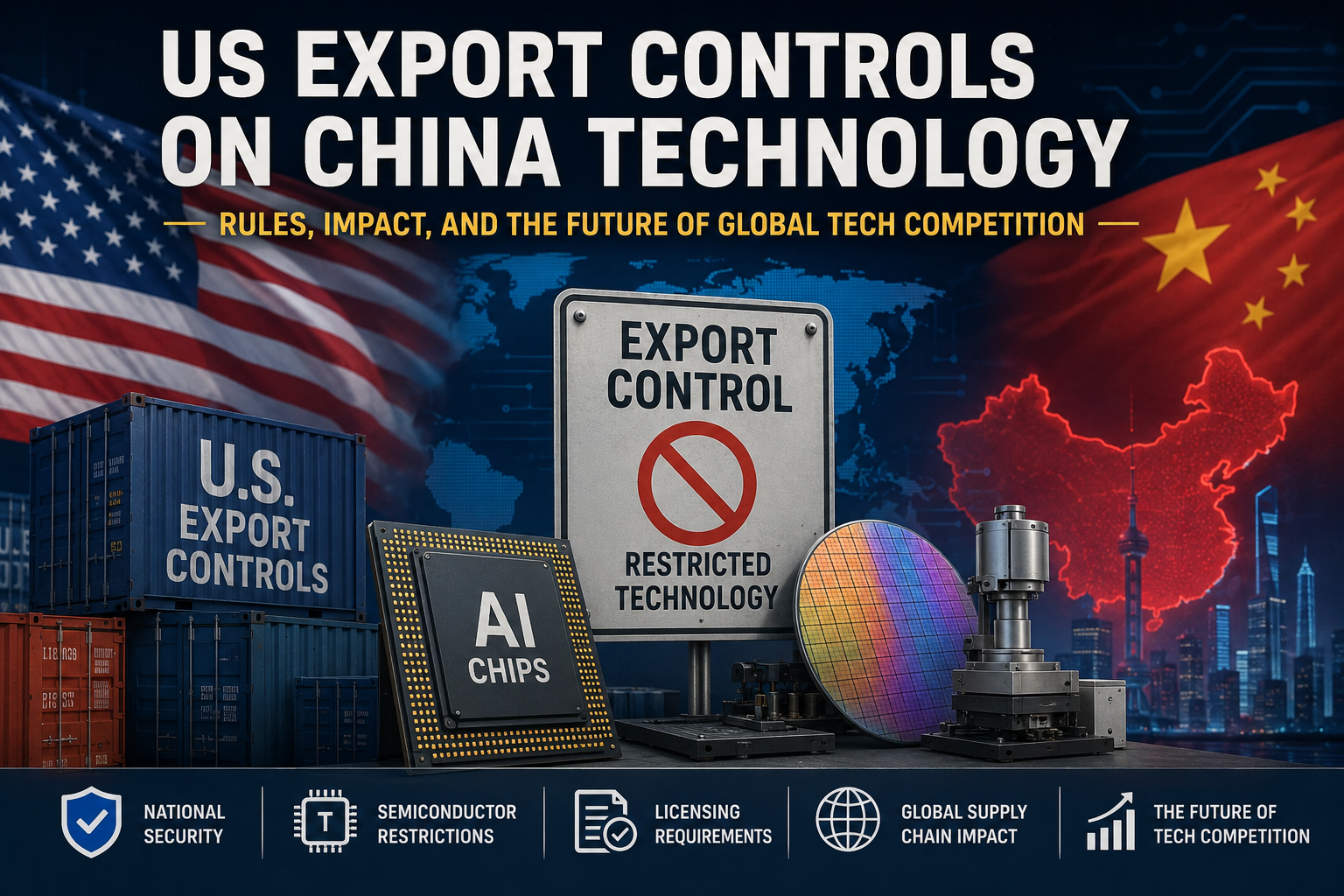
These controls are rules set by the United States government to restrict or limit the export of advanced technologies to China. The goal is to protect national security, maintain technological leadership, and control access to sensitive innovations like semiconductors, artificial intelligence (AI), and supercomputing systems.
In this article, we will explain what these export controls are, why they exist, how they work, and their impact on businesses, global supply chains, and the future of technology.
What Are US Export Controls on China Technology?
US export controls are government regulations that restrict the sale, transfer, or sharing of certain technologies with China.
These rules mainly target:
- Advanced semiconductors and chipmaking tools
- Artificial intelligence (AI) hardware and software
- Supercomputing systems
- Aerospace and defense-related technologies
- Quantum computing components
- High-performance computing equipment
The US government uses agencies like the Bureau of Industry and Security (BIS) to enforce these restrictions.
Why the US Imposes Export Controls on China
There are several strategic and economic reasons behind these policies.
1. National Security Concerns
The US believes that advanced technologies can be used for military purposes. Restricting access reduces the risk of strengthening rival military systems.
2. Protecting Technological Leadership
The United States wants to maintain its lead in critical industries such as AI, chips, and cloud computing.
3. Preventing Dual-Use Technology Risks
Many technologies have both civilian and military uses. Export controls help limit their use in sensitive applications.
4. Economic Competition
The US and China are competing to dominate future industries like AI, 5G, and quantum computing.
Key Areas Targeted by Export Controls
1. Semiconductor Industry
Semiconductors are the foundation of modern electronics. Restrictions affect:
- Advanced chip design tools
- Semiconductor manufacturing equipment
- High-end chips used in AI and defense systems
Companies like NVIDIA have faced limits on selling advanced AI chips to China.
2. Artificial Intelligence (AI)
AI systems require powerful processors and data infrastructure. Export controls restrict:
- High-performance AI chips
- Training models at large scale
- Cloud-based AI computing access
3. Semiconductor Equipment Manufacturing
Companies like ASML play a major role in chip production. Although ASML is not US-based, US rules influence what technologies can be exported globally.
4. Chinese Technology Firms Affected
Major Chinese companies impacted include:
- Huawei
- Semiconductor startups in China
- AI development firms
These firms face restrictions on accessing advanced US technology and software tools.
How US Export Controls Work (Step-by-Step)
Here is a simple breakdown of how the system works:
Step 1: Identification of Sensitive Technology
The US government identifies technologies that could pose security risks.
Step 2: Classification Under Export Control Lists
Technologies are added to control lists such as:
- Commerce Control List (CCL)
- Entity List (restricted companies)
Step 3: Licensing Requirements
Companies must apply for licenses to export controlled items.
Step 4: Approval or Denial
The government reviews requests and decides:
- Approve (rare for advanced tech)
- Deny
- Restrict with conditions
Step 5: Enforcement and Monitoring
Authorities monitor global shipments and enforce penalties for violations.
Major US Export Control Measures Against China
1. Chip Export Restrictions
Limits on exporting advanced AI chips to China.
2. Semiconductor Manufacturing Ban
Restrictions on exporting equipment needed to build advanced chips.
3. Entity List Restrictions
Companies like Huawei are restricted from buying US technology.
4. Foreign Direct Product Rule (FDPR)
Controls products made using US technology anywhere in the world.
Comparison Table: US vs China Tech Strategy
| Category | United States Strategy | China Strategy |
|---|---|---|
| Semiconductors | Restrict exports, maintain dominance | Build domestic chip industry |
| AI Development | Focus on cutting-edge models | Focus on large-scale adoption |
| Supply Chain | Control global tech supply chain | Reduce dependence on US technology |
| Innovation Model | Private sector-driven | State-supported investment |
| Global Reach | Alliances with tech partners | Belt and Road digital expansion |
Impact on Global Technology Industry
1. Supply Chain Disruption
Many companies rely on US-designed chips and tools. Restrictions create delays and shortages.
2. Increased Costs
Companies must redesign products or find alternative suppliers.
3. Fragmentation of Technology Markets
The world is gradually splitting into:
- US-led technology ecosystem
- China-led technology ecosystem
4. Innovation Acceleration in China
China is investing heavily in domestic chip production and AI research.
5. Pressure on Global Companies
Firms must comply with US regulations even if they operate internationally.
Impact on Businesses and Startups
Positive Impacts
- Increased investment in local chip industries
- Growth of alternative technology ecosystems
Negative Impacts
- Limited access to advanced tools
- Higher research and development costs
- Reduced global collaboration
Real-World Example: Semiconductor Competition
The semiconductor industry is at the center of this conflict.
- The US controls most advanced chip design software
- Taiwan produces leading chips (via TSMC)
- China is still developing advanced manufacturing capabilities
This makes semiconductors one of the most strategically important industries in the world.
Future of US Export Controls on China Technology
The future is likely to include:
1. Stricter AI Regulations
More control over AI training chips and cloud systems.
2. Expansion of Entity Lists
More companies may be added to restricted lists.
3. Stronger Global Alliances
The US may coordinate with allies like Japan, South Korea, and the Netherlands.
4. Rise of Tech Decoupling
Two separate technology ecosystems may continue to develop.
Step-by-Step Guide: How Companies Comply with Export Controls
If a company deals with US-origin technology, it must:
Step 1: Check Product Classification
Identify if the product is controlled under US law.
Step 2: Review Export Destination
Check if China or restricted regions are involved.
Step 3: Apply for Export License
Submit application to US authorities.
Step 4: Implement Internal Compliance System
- Train employees
- Track shipments
- Maintain documentation
Step 5: Regular Audits
Ensure ongoing compliance with updated regulations.
Challenges of Export Controls
Despite their goals, these controls face criticism:
- Difficult to enforce globally
- Encourage parallel tech ecosystems
- May slow down global innovation
- Increase geopolitical tensions
FAQs
1. What are US Export Controls on China Technology?
They are rules that restrict the export of advanced US technologies to China for security and strategic reasons.
2. Why does the US restrict technology exports to China?
Mainly for national security, military concerns, and maintaining technological leadership.
3. Which industries are most affected?
Semiconductors, AI, supercomputing, and telecommunications.
4. How does this affect global companies?
Companies face licensing restrictions, higher costs, and supply chain disruptions.
5. Will export controls increase in the future?
Yes, most experts expect tighter controls, especially in AI and semiconductor sectors.
Conclusion
US Export Controls on China Technology are one of the most powerful tools shaping today’s global tech landscape. They affect everything from semiconductor manufacturing to artificial intelligence development.
While the US aims to protect national security and maintain leadership, these controls also reshape global supply chains and accelerate technological independence in China.
In the long term, the world may move toward two parallel technology ecosystems—each developing its own innovation paths, standards, and industries.
Understanding these controls is essential for businesses, policymakers, and anyone following the future of global technology.