
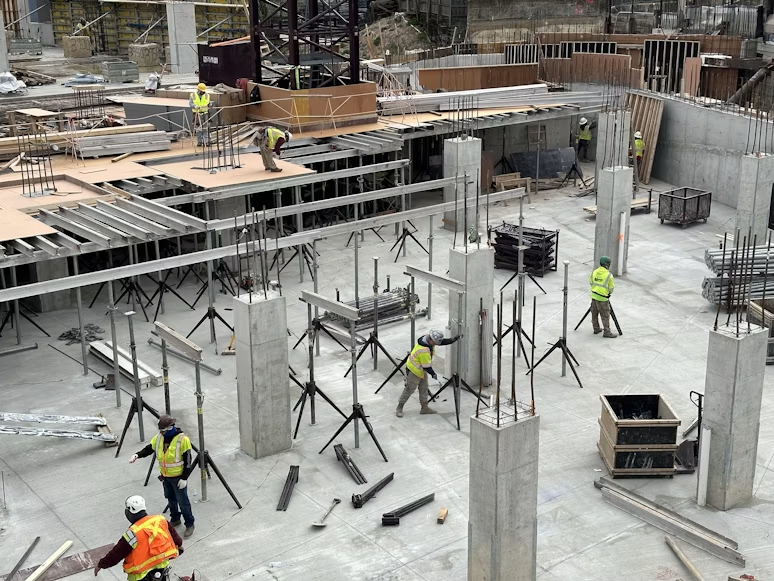
Construction Technology News, The construction industry has spent decades being called “slow to change.” That label doesn’t fit anymore. Walk onto a modern job site today and you’ll see drones mapping terrain, sensors tracking concrete curing in real time, and project managers pulling up 3D models on a tablet instead of unrolling blueprints. This shift isn’t a future promise — it’s happening right now, and it’s reshaping how buildings, roads, and infrastructure get built.
This article breaks down the latest construction technology news, the tools driving real change, and what it all means for contractors, project managers, and anyone watching the industry evolve.
Why Construction Technology News Matters Right Now
Construction firms are dealing with a tough mix of challenges at the same time: rising material costs, a shrinking skilled labor pool, and growing pressure from owners who want faster timelines and better documentation. By 2031, 41% of construction workers are expected to retire, while only 10% of current workers are under 25, signaling a critical shortage of younger talent entering the field. Projections indicate a potential shortage of over two million skilled craft professionals by 2028 if current trends persist.
At the same time, demand isn’t slowing down. A surge in artificial intelligence-driven data center construction and the associated focus on energy infrastructure has led to strong segment growth, and investment in structures is projected to pivot from a 2025 decline to modest growth of nearly 1.8% in 2026, with AI-related data center spending continuing to support engineering and construction work.
This combination — fewer workers, more complex projects, and tighter margins — is exactly why technology adoption has moved from “nice to have” to “necessary to survive.”
Top Construction Technology Trends Making News
Here’s a simple breakdown of the technologies currently shaping headlines in the construction world.
1. Artificial Intelligence Moves from Hype to Daily Use
AI is no longer just a buzzword in construction circles. Roughly 74% of architecture, engineering, and construction firms are already using AI in at least one project phase, and that number keeps climbing. The global AI in construction market is projected to grow from about USD 4.86 billion in 2025 to USD 22.68 billion by 2032.
In practical terms, AI is being used for:
- Estimating project costs more accurately
- Spotting scheduling conflicts before they cause delays
- Reviewing safety footage to flag hazards
- Supporting documentation and project controls
According to one industry report, AI can support estimating, documentation, scheduling, and project controls, but it isn’t a replacement for skilled leadership — it’s a tool that strengthens the people already running the work.
2. Building Information Modeling (BIM) Becomes a Central Data Hub
BIM has been around for years, but its role is changing. It used to be mostly a design tool. Now it’s becoming something bigger.
BIM allows users to create a detailed 3D model of a building that includes all its structures and components in a virtual environment, helping teams detect and correct errors early and build realistic project schedules. Going forward, BIM is expected to integrate more closely with AI, digital twins, and the Internet of Things, evolving from a design tool into a central data platform for the entire building process.
Some firms are also automating routine BIM tasks. BIM automation is moving from niche use cases into everyday workflows, with teams embedding rules directly into models instead of relying purely on manual review cycles.
3. Digital Twins and Reality Capture
A digital twin is a live, digital copy of a physical building or site. It updates as the real structure changes, giving teams an accurate picture without needing to physically inspect every detail.
Reality capture — using drones, 3D scanners, and even smartphones to record site conditions — is becoming easier to use for everyday teams, not just specialists. Reality capture technology is already valuable for precision, safety, and speed, and is expected to become even more accessible in 2026, with user-friendly tools enabling broader data collection and faster decision-making. It is also becoming part of standard project management workflows, helping contractors visually track progress, identify issues quickly, and collaborate on solutions in real time.
4. Modular and Offsite Construction
Building components off-site and assembling them on-site continues to gain traction, particularly for projects with tight deadlines. Modular expansion is being accelerated by advances in 3D modeling and BIM that allow seamless coordination between design intent and factory output, which means fewer surprises and less rework once materials arrive on the job site.
5. Cloud Platforms and Connected Systems
One of the clearest shifts in recent construction technology news is the move away from scattered, disconnected software tools. Contractors are moving beyond basic digital tools and embracing integrated systems that connect accounting, job costing, payroll, field operations, and project management. The reasoning is straightforward: when financial data, labor data, and field activity live in silos, leaders end up making decisions based on incomplete or outdated information.
Cloud-native platforms are also helping distributed teams stay aligned. Cloud-based tools streamline project administration by integrating scheduling, budget monitoring, and document management, while shared platforms reduce version conflicts and miscommunication across teams.
6. Power Infrastructure and Specialized Construction
Data centers, cold storage, and healthcare facilities are driving a different kind of construction demand — one centered on power and reliability. Power has become a bottleneck for many projects since data centers cannot be built without sufficient grid capacity, cold storage facilities require redundant power, and healthcare campuses need uninterruptible systems. Firms that understand power infrastructure and can coordinate closely with utility providers are positioning themselves for premium, specialized work.
7. Equipment Interoperability
Construction fleets are rarely made up of a single equipment brand, which has historically made data-sharing difficult. That’s starting to change. Construction technology vendors are expected to accelerate efforts to improve interoperability, building workflows and integrations that let teams share project data regardless of which software different stakeholders use. This is also extending to fleet interoperability on the job site, making it easier for contractors with mixed equipment fleets to integrate and use technology seamlessly.
Quick Comparison: Key Construction Technologies at a Glance
| Technology | What It Does | Main Benefit | Best Fit For |
|---|---|---|---|
| Artificial Intelligence | Analyzes data for estimating, scheduling, safety | Faster, more accurate decisions | Estimating, project controls, safety monitoring |
| BIM | Creates a detailed 3D model of a building | Fewer design errors, better scheduling | Design coordination, complex projects |
| Digital Twins | Live digital copy of a physical site/building | Real-time monitoring without site visits | Facility management, large infrastructure |
| Reality Capture | Drones, scanners, mobile mapping | Accurate, fast progress tracking | Site documentation, progress reporting |
| Modular Construction | Off-site fabrication, on-site assembly | Shorter timelines, less rework | Hotels, schools, data centers |
| Cloud Platforms | Connects field and office data | Eliminates data silos | Multi-team, multi-site operations |
How These Technologies Are Solving Real Problems
It helps to look at construction technology not just as “new tools,” but as direct answers to industry pain points.
Problem: Labor shortages. With fewer skilled workers available, the industry must attract an estimated 499,000 net new workers in 2026 just to keep pace with demand, even as job growth has slowed. Technology helps by automating repetitive tasks, reducing the number of people needed for documentation and tracking, and helping smaller teams manage more complex projects.
Problem: Inaccurate budgeting and forecasting.
Contractors are now expected to back decisions with data, especially when it comes to bidding, forecasting, and cash flow management, using analytics to identify which job types are most profitable and where costs are being underestimated. This reduces guesswork and protects margins.
Problem: Coordination breakdowns between design and field teams.
Connected BIM and cloud platforms keep everyone working from the same updated model and data set, cutting down on the costly miscommunication that leads to rework.
Problem: Safety and accountability.
Owners and insurers increasingly want documented proof of what happened on site and when. Reality capture and connected reporting tools give teams a clear, time-stamped record, reducing disputes and improving safety compliance.
What This Means for Construction Professionals
It’s worth being clear about something important: technology is a tool, not a replacement for skilled leadership. As one industry analysis put it, technology can help, but it does not replace leadership — it exposes weak leadership faster. A team with strong processes and experienced project managers will get far more value out of new software than a team that adopts tools without a clear plan.
For professionals working in or entering the field, here’s what matters most right now:
- Get comfortable with at least one BIM or cloud-based project management platform
- Understand how data and reporting tools support — not replace — your judgment on site
- Pay attention to specialized sectors like data centers and healthcare, where technology adoption is happening fastest
- Treat documentation and data accuracy as part of the job, not an extra task
Step-by-Step: How Construction Firms Are Adopting New Technology
For firms wondering where to start, the typical adoption path looks like this:
Identify the biggest pain point first.
Is it scheduling delays, budget overruns, or poor communication between field and office? Start there instead of trying to adopt everything at once.
Choose connected, construction-specific software.
General-purpose tools often don’t fit construction workflows well. Industry-specific platforms tend to integrate job costing, payroll, and field data more effectively.
Train the team before scaling up.
Technology only works if people actually use it correctly. A short, focused training period prevents wasted investment.
Start with one project or one team.
Testing new tools on a smaller scale makes it easier to fix issues before a company-wide rollout.
Review the data regularly.
The whole point of these tools is better decision-making — that only happens if someone is actually looking at the reports and acting on them.
Expand gradually.
Once a tool proves its value, extend it to more projects and teams rather than forcing a sudden, company-wide switch.
Frequently Asked Questions
What is the biggest construction technology trend right now?
Artificial intelligence and connected cloud platforms are currently getting the most attention, largely because they directly address labor shortages and the need for better, faster decision-making.
Is AI going to replace construction workers?
No. AI is mainly being used to support tasks like estimating, scheduling, documentation, and safety monitoring. It assists skilled workers and project managers rather than replacing them.
What is the difference between BIM and a digital twin?
BIM is primarily a design and modeling tool used during planning and construction. A digital twin is a live, continuously updated digital copy of a building or site that reflects real-world conditions even after construction is complete.
Why is modular construction becoming more popular?
Better 3D modeling and BIM coordination now make it easier to plan offsite fabrication accurately, which shortens project timelines and reduces costly on-site rework.
Do small construction companies need this technology too?
Yes, though the approach should be scaled to fit the company’s size. Even basic cloud-based scheduling or job-costing tools can meaningfully reduce errors and save time for smaller firms.
What sectors are leading construction technology adoption?
Data centers, healthcare facilities, and power infrastructure projects are currently leading adoption, largely because they require tighter coordination, stricter compliance, and more detailed documentation than standard commercial projects.
Conclusion
Construction technology news in 2026 tells a consistent story: the industry is moving from experimenting with new tools to actually depending on them. AI, BIM, digital twins, modular construction, and connected cloud platforms aren’t separate trends — they’re pieces of the same shift toward smarter, faster, and more accountable project delivery.
None of this technology works in isolation, though. The firms seeing real results are the ones pairing these tools with strong leadership, clear processes, and well-trained teams. As labor shortages persist and project complexity grows, the gap between firms that adopt technology thoughtfully and those that don’t is only going to widen.
Whether you’re a contractor, project manager, or simply following the industry, keeping an eye on these developments isn’t optional anymore — it’s part of understanding where construction is headed next.